


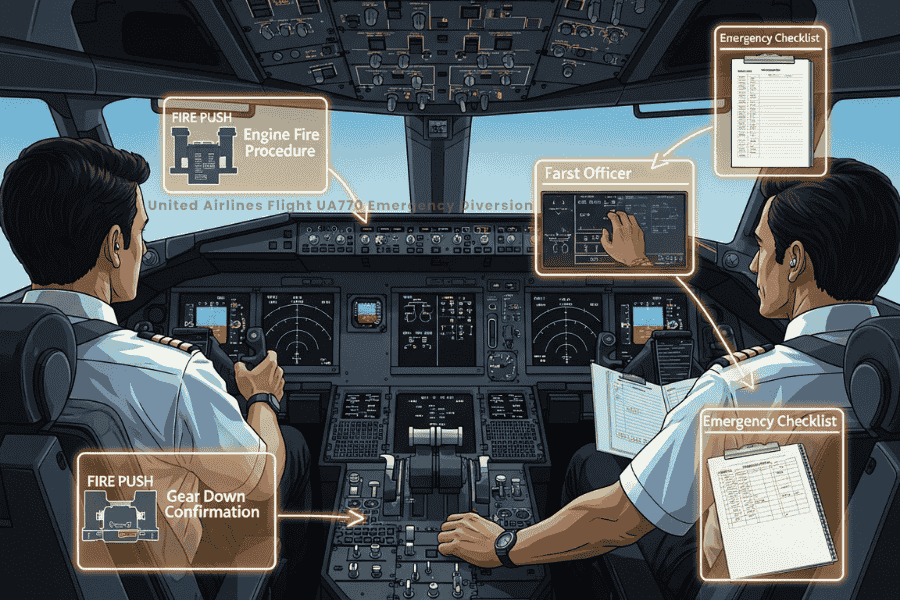
When passengers board commercial aircraft, they trust that every measure has been taken to ensure their safe arrival at their destination. However, aviation emergencies do occur, and how airlines respond defines their commitment to passenger safety. The United Airlines flight UA770 emergency diversion stands as a compelling example of modern aviation’s sophisticated safety protocols and the professionalism displayed by flight crews during unexpected situations.
On multiple occasions throughout 2025, United Airlines flight UA770 emergency diversion incidents have captured public attention, demonstrating both the unpredictability of air travel and the remarkable preparedness of commercial aviation. From technical anomalies detected mid-flight to precautionary landings at alternative airports, these events reveal the complex decision-making processes that prioritize passenger safety above all operational considerations.
Understanding the United Airlines Flight UA770 Route and Operations
United Airlines flight UA770 operates as a regular transatlantic service connecting Barcelona’s Josep Tarradellas Barcelona–El Prat Airport to Chicago’s O’Hare International Airport. This long-haul route typically covers approximately 4,300 nautical miles and requires roughly nine hours of flight time under normal conditions. The service primarily utilizes Boeing 787-9 Dreamliner aircraft, known for their advanced avionics, fuel efficiency, and passenger comfort features.
| Route Details | Specifications |
|---|---|
| Origin Airport | Barcelona (BCN) |
| Destination Airport | Chicago O’Hare (ORD) |
| Typical Aircraft | Boeing 787-9 Dreamliner |
| Flight Distance | Approximately 4,300 nautical miles |
| Average Flight Duration | 9 hours 15 minutes |
| Passenger Capacity | 257–280 passengers |
| Crew Complement | 12–14 members |
The Boeing 787-9 Dreamliner represents cutting-edge aviation technology, featuring composite materials that reduce weight, advanced environmental control systems, and sophisticated monitoring capabilities that continuously track aircraft performance. These technological advantages make the 787-9 an ideal choice for demanding transatlantic routes, though no aircraft is completely immune to technical irregularities.
The Barcelona to Chicago Route: A Transatlantic Challenge
The United Airlines flight UA770 emergency diversion incidents typically occurred during the most challenging portion of transatlantic flight operations. When aircraft reach cruising altitude over the Atlantic Ocean, they enter a phase where alternative landing options become temporarily limited. Pilots must carefully balance fuel consumption, weather conditions, and emergency preparedness throughout the oceanic crossing.
During peak season, flight UA770 carries business travelers, tourists, and families connecting between Europe and North America. The route’s popularity means that any United Airlines flight UA770 diversion creates significant operational challenges, affecting not just the passengers aboard but also connecting flights and airline scheduling across the network.
Timeline of the United Airlines Flight UA770 Emergency Diversion Events
Multiple United Airlines flight UA770 emergency diversion events occurred throughout 2025, each with distinct characteristics and causes. Understanding the timeline helps contextualize how aviation safety protocols function in real-world scenarios.
The May 2025 Incident: Cabin Pressurization Concerns
On May 27, 2025, flight UA770 departed Barcelona as scheduled, carrying passengers expecting a routine journey to Chicago. Approximately ninety minutes into the flight, while cruising at 37,000 feet over the Atlantic, the flight crew detected irregularities in the cabin pressurization system. The captain immediately declared an emergency using the internationally recognized transponder code 7700, alerting air traffic control to the situation.
The United Airlines flight UA770 diversion to London Heathrow demonstrated textbook emergency management. Rather than continuing across the Atlantic with uncertain cabin pressure integrity, the crew opted for a precautionary diversion to London Heathrow Airport, one of Europe’s best-equipped facilities for handling aviation emergencies. The aircraft landed safely at 4:55 PM British Summer Time on Runway 27R, with emergency response teams positioned and ready despite ultimately not being required.
| May 2025 Incident Timeline | Details |
|---|---|
| Departure Time | 2:30 PM CEST from Barcelona |
| Issue Detection | Approximately 90 minutes after takeoff |
| Emergency Declaration | Squawk 7700 transmitted |
| Diversion Airport | London Heathrow (LHR) |
| Landing Time | 4:55 PM BST |
| Passengers Affected | 257 passengers |
| Injuries Reported | Zero |
The July 2025 Incident: Technical System Anomalies
A separate United Airlines flight UA770 emergency diversion occurred on July 28, 2025, though this incident involved a different set of circumstances. After departing San Francisco bound for Chicago, the flight crew detected unusual indicators related to critical aircraft systems approximately ninety minutes into the journey. Following established safety protocols, the captain declared an emergency and diverted to Denver International Airport.
The Denver diversion showcased how United Airlines flight UA770 diversion procedures adapt to geographical context. Denver International Airport offers excellent emergency response capabilities and serves as a major United Airlines hub, providing immediate access to maintenance personnel, replacement aircraft, and passenger rebooking infrastructure.
What Triggered These Emergency Diversions?
Understanding the causes behind United Airlines flight UA770 emergency diversion incidents requires examining both the technical and human factors that influence aviation safety decisions. Modern aircraft generate thousands of data points throughout each flight, and flight crews must interpret this information while managing passenger comfort and operational efficiency.
Cabin Pressurization Systems: Critical Safety Components
The cabin pressurization concerns that prompted the United Airlines flight UA770 emergency diversion to London Heathrow highlight one of aviation’s most critical safety systems. Commercial aircraft maintain cabin pressure equivalent to approximately 8,000 feet altitude, even while cruising at 37,000 feet or higher. This pressurization allows passengers and crew to breathe comfortably without supplemental oxygen.
When pressurization systems malfunction or display irregular readings, flight crews face serious decisions. Even if oxygen masks do not deploy and passengers remain unaware of any issue, pilots cannot ignore warning indicators. The consequences of cabin depressurization at cruise altitude include hypoxia, which can cause unconsciousness within minutes at high altitudes.
Technical Warning Systems and Crew Response
Modern aircraft like the Boeing 787-9 feature sophisticated monitoring systems that detect anomalies before they escalate into emergencies. During the various United Airlines flight UA770 diversion events, flight crews received warning signals that, while not confirming immediate danger, indicated potential problems requiring investigation.
Aviation safety philosophy embraces a “better safe than sorry” approach. When pilots receive warnings about critical systems, they must decide whether continuing to the destination represents acceptable risk. In the case of United Airlines flight UA770 emergency diversion incidents, crews consistently chose precaution over convenience, demonstrating the industry’s unwavering commitment to safety.
The Decision-Making Process Behind Emergency Diversions
Every United Airlines flight UA770 emergency diversion involves complex decision-making that balances multiple factors simultaneously. Captains must consider passenger safety, aircraft capabilities, weather conditions, available diversion airports, and operational logistics within compressed timeframes.
Evaluating Diversion Airport Options
When declaring an emergency, pilots must quickly identify suitable diversion airports. For the transatlantic United Airlines flight UA770 diversion to London Heathrow, several factors made Heathrow the optimal choice:
- Proximity to the flight path: Heathrow lies along the great circle route between Barcelona and Chicago
- Emergency response capabilities: As one of Europe’s largest airports, Heathrow maintains comprehensive emergency services
- Technical support: Major maintenance facilities can diagnose and repair complex aircraft systems
- Passenger services: Hotel accommodations, rebooking options, and ground transportation are readily available
- Weather reliability: Heathrow operates in most weather conditions with multiple runways and advanced approach systems
| Diversion Airport Evaluation Criteria | London Heathrow | Denver International |
|---|---|---|
| Distance from incident location | Approximately 800 miles | Approximately 600 miles |
| Emergency response rating | Excellent | Excellent |
| United Airlines hub status | No | Yes |
| Maintenance facilities | Available | Comprehensive |
| Passenger accommodation capacity | High | Very High |
Communication with Air Traffic Control
During every United Airlines flight UA770 emergency diversion, seamless communication between flight crews and air traffic control proved essential. The emergency transponder code 7700 provides immediate priority handling, clearing airspace and expediting the aircraft’s path to the diversion airport.
Air traffic controllers coordinate with multiple agencies during emergencies, including airport emergency services, airline operations centers, and national aviation authorities. This coordination ensures that when United Airlines flight UA770 emergency diversion aircraft approach their unplanned destination, everything stands ready to receive them safely.
Passenger Experience During the Emergency Diversions
The human element of United Airlines flight UA770 emergency diversion events often receives less attention than technical details, yet passenger experiences reveal much about airline emergency management quality. Modern passengers possess unprecedented awareness of flight operations through personal devices, flight tracking applications, and social media connectivity.
Cabin Crew Communication and Passenger Management
During the May 2025 United Airlines flight UA770 emergency diversion to London Heathrow, cabin crew demonstrated exceptional professionalism in managing passenger expectations and emotions. Flight attendants received training specifically designed for emergency situations, enabling them to project calm confidence while ensuring compliance with safety procedures.
Passenger testimonials from various United Airlines flight UA770 diversion incidents consistently praised crew communication. Rather than creating panic through dramatic announcements, crews provided factual information that acknowledged the situation without catastrophizing. This measured approach helped maintain order in the cabin and prevented anxiety from escalating.
Post-Landing Passenger Support
Once United Airlines flight UA770 emergency diversion aircraft landed safely, the focus shifted to passenger care and logistics. Airlines face significant challenges when diversions occur, particularly on international routes where passengers may lack appropriate visas, local currency, or knowledge of the diversion destination.
United Airlines provided comprehensive support following each incident:
- Meal vouchers: Compensation for unexpected dining expenses during delays
- Hotel accommodations: Overnight lodging when same-day rebooking proved impossible
- Rebooking assistance: Priority placement on subsequent flights to final destinations
- Communication support: International calling cards and internet access for contacting family
- Ground transportation: Shuttle services between airports and hotels
| Passenger Support Services | Details |
|---|---|
| Meal compensation | $50-75 vouchers per passenger |
| Hotel arrangements | 3–4 star properties near airport |
| Rebooking timeline | Within 4–6 hours of landing |
| Customer service representatives | Dedicated team at diversion airport |
| Luggage handling | Expedited transfer to connecting flights |
The Role of Modern Aircraft Technology
The United Airlines flight UA770 emergency diversion incidents demonstrate how advanced aircraft systems contribute to aviation safety. Boeing 787-9 Dreamliners incorporate multiple redundant systems and real-time monitoring capabilities that previous aircraft generations lacked.
Health Monitoring Systems in the Boeing 787-9
One factor that enabled successful United Airlines flight UA770 emergency diversion management was the aircraft’s sophisticated health monitoring system. The 787-9 continuously transmits performance data to airline operations centers, allowing ground-based engineers to analyze situations simultaneously with flight crews.
When cabin pressurization warnings appeared during the flight to London, United Airlines engineers received the same information in real-time. This allowed them to prepare maintenance teams, source replacement parts if necessary, and coordinate with airport authorities before the aircraft landed. Such parallel processing dramatically improves emergency response efficiency.
Redundancy and Backup Systems
Commercial aviation embraces redundancy as a fundamental safety principle. The Boeing 787-9 features backup systems for virtually every critical function, ensuring that single-point failures rarely threaten flight safety. During United Airlines flight UA770 emergency diversion events, these redundancies provided crews with confidence that immediate catastrophic failure remained unlikely, allowing measured decisions rather than panic responses.
Regulatory Oversight and Investigation Processes
Following each United Airlines flight UA770 emergency diversion, regulatory authorities initiated review processes to ensure proper procedures were followed and identify potential improvements. The Federal Aviation Administration (FAA) in the United States and the European Aviation Safety Agency (EASA) maintain overlapping jurisdiction for transatlantic flights.
FAA and EASA Coordination
International flights like UA770 require coordination between multiple regulatory bodies. When the United Airlines flight UA770 emergency diversion to London Heathrow occurred, both American and European authorities reviewed the incident. This dual oversight ensures comprehensive safety analysis and prevents regulatory gaps.
Investigations typically examine:
- Mechanical systems that triggered warnings
- Crew decision-making processes and timing
- Communication between flight crew and air traffic control
- Passenger safety throughout the incident
- Airline maintenance records and procedures
- Manufacturer technical bulletins and service recommendations
| Investigation Focus Areas | Responsible Authority |
|---|---|
| Aircraft technical systems | Boeing and FAA |
| Crew procedures and training | FAA and United Airlines |
| Air traffic control handling | National aviation authorities |
| Passenger safety protocols | FAA and airline quality assurance |
| Maintenance history | FAA and manufacturer |
Learning from Emergency Events
Every United Airlines flight UA770 emergency diversion provides valuable learning opportunities for the entire aviation industry. Rather than viewing diversions as failures, aviation professionals recognize them as successful applications of safety protocols that prevented potentially dangerous situations from developing.
Data collected from these incidents influences future training programs, maintenance procedures, and aircraft design improvements. When patterns emerge across multiple events, manufacturers and airlines implement proactive changes that enhance safety for millions of future passengers.
Industry-Wide Emergency Diversion Statistics
Placing United Airlines flight UA770 emergency diversion incidents within broader industry context reveals important perspectives. Emergency diversions, while newsworthy, represent a tiny fraction of total flight operations, occurring approximately once per 1,500 flights according to industry data.
Frequency and Common Causes
Airlines worldwide execute thousands of successful flights daily, and the vast majority proceed without incident. When diversions occur, the most common triggers include:
- Medical emergencies: Passenger or crew health crises requiring immediate ground-based care
- Technical warnings: System alerts that require investigation before continuing
- Weather conditions: Unexpected severe weather at destination airports
- Fuel concerns: Headwinds or routing changes affecting fuel reserves
- Security issues: Disruptive passengers or credible threats
The United Airlines flight UA770 emergency diversion technical issues fall within the second category, representing proactive responses to system warnings rather than confirmed equipment failures.
Aviation Safety Culture and Continuous Improvement
The handling of United Airlines flight UA770 emergency diversion events exemplifies modern aviation’s robust safety culture. This culture prioritizes prevention over reaction, encourages reporting of safety concerns without fear of punishment, and continuously seeks improvement opportunities.
Crew Training and Simulation
Flight crews preparing to operate routes like UA770 undergo extensive training that includes emergency simulation. Pilots practice diversion scenarios in full-motion flight simulators that replicate the Boeing 787-9’s handling characteristics with remarkable fidelity. These simulations prepare crews for the stress and rapid decision-making required during actual emergencies.
Cabin crew receive complementary training focused on passenger management, emergency equipment operation, and coordination with flight deck personnel. The professionalism displayed during United Airlines flight UA770 diversion incidents reflects thousands of hours of collective training investment.
Maintenance Excellence and Prevention
Behind every United Airlines flight UA770 emergency diversion investigation lies scrutiny of maintenance practices. Modern airlines follow rigorous inspection schedules that examine aircraft systems at multiple intervals, from daily preflight checks to comprehensive overhauls requiring weeks of downtime.
Boeing 787-9 aircraft undergo checks categorized by increasing thoroughness:
| Maintenance Check Type | Frequency | Duration | Scope |
|---|---|---|---|
| Pre-flight inspection | Before every flight | 30–45 minutes | Visual checks of critical systems |
| A-Check | Every 500–800 flight hours | 10–20 hours | Systems inspection and minor servicing |
| C-Check | Every 18–24 months | 1–2 weeks | Detailed inspection of airframe and systems |
| D-Check | Every 6–10 years | 1–2 months | Complete aircraft teardown and rebuild |
Effective maintenance programs detect and correct problems before they manifest as in-flight warnings, though no system achieves perfection. The goal remains minimizing incidents while preparing crews to handle those that inevitably occur.
Lessons for Passengers from Emergency Diversions
While United Airlines flight UA770 emergency diversion events may seem concerning to travelers, they actually demonstrate aviation safety’s remarkable effectiveness. Several key lessons emerge for passengers:
Trust the Process and Crew
Flight crews receive training far exceeding what passengers typically realize. When crews announce diversions, they have evaluated multiple factors and concluded that landing represents the safest course of action. Passenger cooperation during these events significantly contributes to positive outcomes.
Emergency Diversions Prioritize Prevention
Most diversions occur not because catastrophic failure is imminent but because prudent risk management dictates investigating potential issues. The United Airlines flight UA770 diversion to London Heathrow resulted from warning indicators, not confirmed system failures. This preventive approach saves lives by avoiding situations where problems could escalate.
Modern Aviation Remains Remarkably Safe
Despite media attention to incidents like the United Airlines flight UA770 emergency diversion, air travel remains the safest form of long-distance transportation. Statistical analysis consistently shows that passengers face greater risks during ground transportation to and from airports than during flights themselves.
The Future of Aviation Safety and Emergency Response
Examining United Airlines flight UA770 emergency diversion incidents provides insights into aviation safety’s continuing evolution. Several technological and procedural developments promise to further enhance passenger safety in coming years.
Predictive Maintenance and Artificial Intelligence
Airlines increasingly employ artificial intelligence systems that analyze aircraft performance data to predict potential failures before they occur. These systems might identify the warning patterns that led to United Airlines flight UA770 diversion events earlier in the maintenance cycle, potentially preventing in-flight alerts entirely.
Machine learning algorithms can detect subtle degradation trends invisible to human technicians, enabling proactive component replacement before reliability thresholds are crossed. As these technologies mature, the frequency of technical diversions should decline while safety margins increase.
Enhanced Communication Systems
Future aircraft will feature improved communication capabilities that provide flight crews with enhanced information during emergencies. Rather than relying solely on onboard systems, pilots may consult with ground-based experts in real-time, accessing diagnostic data and recommendations that inform diversion decisions.
These enhanced capabilities will particularly benefit situations like the United Airlines flight UA770 emergency diversion, where uncertain system status required crews to make conservative choices with limited information. Better data means better decisions without compromising safety margins.
Economic and Operational Impacts of Emergency Diversions
While passenger safety remains paramount, United Airlines flight UA770 diversion incidents carry significant economic consequences that airlines carefully manage.
Direct Costs of Diversions
Each unplanned landing generates substantial expenses:
- Fuel costs: Additional fuel consumed during diversion routing
- Landing fees: Airports charge fees based on aircraft weight and services used
- Passenger accommodation: Hotel rooms, meals, and ground transportation
- Crew expenses: Additional crew rest requirements and overtime considerations
- Aircraft repositioning: Flying empty aircraft to resume scheduled routes
- Maintenance inspection: Detailed examination of systems triggering warnings
| Diversion Cost Categories | Estimated Expense Range |
|---|---|
| Immediate operational costs | $50,000–150,000 |
| Passenger compensation and services | $75,000–200,000 |
| Aircraft maintenance inspection | $25,000–100,000 |
| Schedule disruption and repositioning | $100,000–300,000 |
| Total estimated cost per diversion | $250,000–750,000 |
Schedule and Network Impacts
Beyond direct costs, United Airlines flight UA770 emergency diversion events create ripple effects throughout airline networks. Aircraft positioned in unplanned locations must be repositioned, potentially affecting multiple subsequent flights. Crew members who exceed duty time limits require replacement, drawing personnel from reserve pools or disrupting other routes.
Despite these challenges, airlines consistently prioritize safety over economic considerations. The financial costs of diversions pale compared to potential consequences of continuing flights with uncertain system integrity.
Public Perception and Media Coverage
United Airlines flight UA770 emergency diversion incidents generate significant media attention, which shapes public perception of aviation safety. Understanding how these events are reported and discussed provides valuable context for travelers.
The Role of Social Media
Modern passengers frequently document their experiences during unusual flights, posting updates to social media platforms in real-time. During United Airlines flight UA770 emergency diversion events, passengers shared experiences via Twitter, TikTok, and Instagram, providing unfiltered perspectives that traditional media later amplified.
While this democratization of information increases transparency, it can also spread misinformation or amplify anxiety. Passengers posting during emergencies may lack technical knowledge to accurately interpret situations, leading to dramatic characterizations of events that crews had well under control.
Balancing Transparency and Context
Airlines face challenges balancing transparency about incidents with providing appropriate context. Simply stating “United Airlines Flight UA770 experienced an emergency diversion” sounds alarming without explaining that such diversions represent standard safety protocols functioning exactly as designed.
Effective communication acknowledges passenger concerns while emphasizing that diversions demonstrate aviation safety working properly rather than failing. The United Airlines flight UA770 emergency diversion incidents showcase crews making appropriate decisions that protected everyone aboard.
FAQs
Q: Why did United Airlines Flight UA770 divert in 2025?
A: Multiple diversions occurred due to technical warnings and cabin-pressurization irregularities, prompting precautionary landings for safety.
Q: Were any passengers injured during the UA770 emergency diversions?
A: No. All reported diversions resulted in safe landings with zero injuries.
Q: What aircraft usually operates UA770?
A: The Boeing 787-9 Dreamliner, known for advanced monitoring systems and long-haul efficiency.
Q: How do crews decide where to divert during an emergency?
A: Pilots evaluate proximity, airport emergency capabilities, weather, and maintenance availability before selecting the safest diversion airport.
Q: What support does United provide after an emergency diversion?
A: Meal vouchers, hotel stays, rebooking assistance, ground transport, and communication support for all affected passengers.
Conclusion
The multiple United Airlines flight UA770 emergency diversion incidents throughout 2025 tell a consistent story of aviation safety protocols functioning as intended. From the moment warning indicators appeared until passengers safely reached final destinations, trained professionals executed established procedures that prioritized lives above all other considerations.
These events remind travelers that modern commercial aviation maintains extraordinary safety records through continuous vigilance, comprehensive training, advanced technology, and willingness to accept operational inconvenience when safety requires it. Every successful diversion reinforces confidence that airlines will make difficult but correct decisions during unexpected situations.
Future passengers boarding United Airlines flight UA770 or similar routes can take comfort knowing that should unusual circumstances arise, sophisticated systems, prepared crews, and robust protocols stand ready to ensure their safe arrival, even if that arrival occurs at an unplanned destination. In aviation, arriving safely always matters more than arriving on schedule, and the United Airlines flight UA770 emergency diversion events exemplify this fundamental truth.
